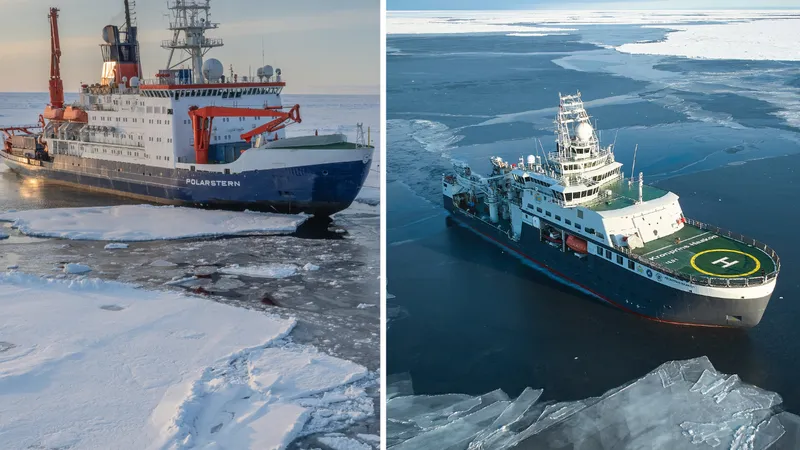
LAMEX 1 is underway: Polarstern has left Tromsø for the central Arctic Ocean
Wednesday, August 12th, 2026
RV Polarstern left Tromsø, Norway, on 6 August 2026 at 5 pm local time, beginning the 70-day LAMEX 1 expedition (PS156) into the central Arctic Ocean. On board is a science party of some 40 researchers, students, technicians, engineers and a media team from institutions in Germany, Norway, Italy, Argentina and the USA, together with the ship's crew. The expedition is led by Catalina Gebhardt (chief scientist) and Juliane Müller (co-lead), both AWI, and will end in Bremerhaven, Germany, on 14 October 2026.
The first days
Polarstern cast off in Tromsø and headed north in sunshine, through the spectacular fjord landscape around the city. Work on board started almost immediately: preparing the laboratories, setting up the scientific instruments and equipment, and briefing the whole team – those who have sailed many times before as well as those on a research vessel for the first time – on life on board and on the handling of the scientific systems. The transit north was used to have everything ready before the first station.
On 9 August, Polarstern reached the pilot station off Longyearbyen for a last crew change and left again the same day. Spitsbergen proved a busy place: the Norwegian research vessel FF Helmer Hanssen lay alongside during the wait, and on the way out through the Isfjord the Swedish research icebreaker IB Oden came into view. The course is now west, toward Greenland.
What we are looking for
The warming of the Arctic is not a forecast; it is happening now. It is causing distinct and severe changes in ecosystems and in the interactions between atmosphere, ice and ocean, and it is shifting physical parameters so strongly that the effects reach into the global circulation. The retreat of the sea ice is an alarming development, yet it opens access to regions that were impossible to investigate before because of the harsh ice conditions. LAMEX 1 is taking that opportunity: the expedition is heading for parts of the central Arctic Ocean from which almost no record of the past exists – the Last Ice Area off northern and northeastern Greenland and the western Lomonosov and Alpha ridges.
The scientific program
- Geophysics. Continuous multibeam swath bathymetry (HYDROSWEEP) and sub-bottom profiling (PARASOUND), multichannel seismic reflection profiling with a GI-Gun source and a 600 m streamer adapted for ice conditions, plus continuous gravity and magnetic measurements. The work will add data from regions where existing coverage is sparse and little is known: the Last Ice Area and the northern Greenland margin, the Morris Jesup Rise and Spur, Klenova Valley, the western and central Lomonosov Ridge, and – ice permitting – the Alpha Ridge. These data will also help guide where the sediment cores are taken. A key objective is to tie new seismic profiles to the ACEX drill site, the only long drill record from the central Arctic Ocean, so that basin-wide seismic horizons can finally be dated and correlated.
- Marine geology. Sediment coring with gravity corer, Kastenlot, multicorer and boxcorer in the same areas. The recovered material will be analyzed with a multi-proxy approach combining organic geochemistry, micropaleontology, sedimentology, inorganic geochemistry and sedimentary ancient DNA (sedaDNA), with dating by biostratigraphy, isotope stratigraphy, paleomagnetics, radiocarbon, cosmogenic and radiogenic nuclides.
- Physical oceanography. Characterizing the structure and circulation of water masses around the major bathymetric features, and following up on the 2025 EGC-Sources expedition (PS150) by investigating the East Greenland Current – the main export route for Arctic freshwater and sea ice to the North Atlantic – and the poorly known boundary current north of Greenland that is thought to feed it.
- Solid Earth and ice (Deglaseis and HOLGREEN). Seismological and geodetic GNSS work in Northeast Greenland to test whether the region's unusual earthquake activity is driven by tectonics or by rebound of the crust following past and ongoing deglaciation, and to measure bedrock displacement caused by present-day ice-mass loss of the Greenland Ice Sheet.
Alongside the science, the expedition will identify suitable sites for future scientific deep drilling and for long-core recovery with suitable coring equipment during LAMEX 2 and beyond.
How the cruise will run
The exact route depends on sea-ice conditions. After Longyearbyen, the program starts with recovering and servicing instruments deployed during EGC-Sources – at the 79°N Glacier, in the central Fram Strait, at the northeastern tip of Greenland and near Independence Fjord. The main working phase then moves to the Morris Jesup Rise and Spur, along the Lomonosov Ridge and, if the ice allows, onto the Alpha Ridge, before Polarstern turns south for Bremerhaven.
Three professional marine mammal observers are aboard for the whole expedition, and above all for the duration of the seismic work, with a mitigation protocol in place during all operations of the seismic source.
Follow LAMEX 1:
Cruise blog on the RV Polarstern website: https://onexpedition.awi.de/polarstern
AWI expeditions website: https://www.awi.de/en/science/geosciences/geophysics/expeditions.html